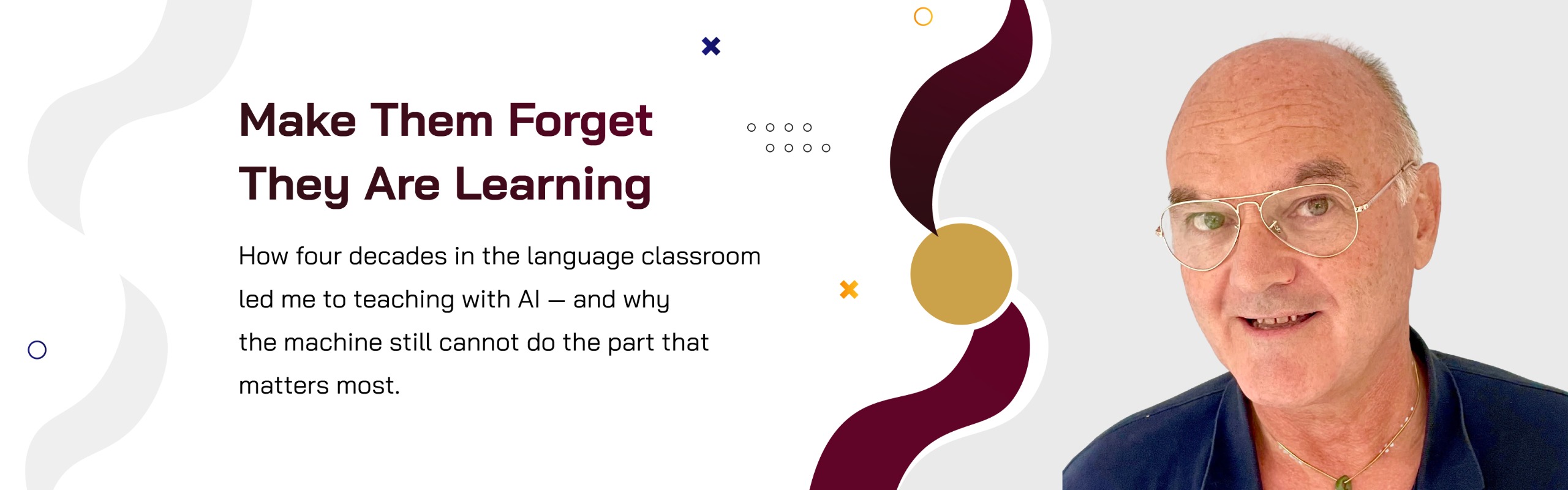
How four decades in the language classroom led me to teaching with AI — and why the machine still cannot do the part that matters most.
By Hansjürg Perino · Teacher Trainer, AI Team Leader, Digital Learning Hub Sek II, Canton of Zurich · pincoach.ch
Last spring a young woman sat her oral school-leaving exam in English literature. She discussed Shaw’s Pygmalion, defended her reading, fielded the follow-up questions. At the end she was given a grade — 5.5 out of 6 — with written feedback and a full transcript of the conversation. There was no examiner in the room. The examiner was a chatbot I had built. When my colleague Michael Beusch and I, both long-term experienced English teachers, checked the result against our own judgement – we would have awarded the exact same mark.
I am not telling that story to impress anyone with the technology. I am telling it because it confirms one conviction that I have held since my very first steps in a classroom: make learners forget that they are learning, and learning happens almost by itself. Create trust, offer choice, get them engaged. In this case, it was the Advanced Voice Mode of an AI chatbot that was prompted well enough to fully enthrall the student, engage her in a high-level literary conversation and make her forget she was actually practising for an exam.
Let’s look at another example. Take a coursebook unit on famous speeches, with extracts thereof printed on the page and a photograph of the speaker. Great basis to work with, but I hunted down every one of those speeches on YouTube so the class could hear the rhythm and the intonation of those famous voices. After discussion and analysis of the rhetoric, the students wrote and delivered their own short keynote — to the class, or only to me if they preferred. The coursebook was the starting point, not the ceiling. Nobody was “doing exercises.” They were creating something with their own fingerprints on it, and the language came along as they were hungry to polish their little masterpieces.
I have been inspired by the theory of “suggestopedia” by Lozanov (later termed desuggestopedia in Larsen-Freeman) to create such moments of “learning by the by”, and have tried to make them happen in my teaching English, French and Spanish at Swiss Gymnasium level – or when I trained future English teachers as a lecturer at the University of Zurich. Recordings of my lessons at Gymnasium were used for a long time at PHZH, the Zürich teacher-training college, as benchmark examples of classroom best practice.
As for technology, I did not come to artificial intelligence trying to chase the latest fashion. I have been the “technology teacher” (not only for ICT, but in the language classroom) since way before it was acknowledged as a method. I also ran my school’s ICT department in the late 1990s, presided over the Swiss Association for Informatics in Education, and spent a British Council summer school on “video, audio and new technologies in the teaching of English” back in 1998. In all my teaching years, I have asked one question about every new tool — does it add to students’ learning and independence? And also: is it practical, handy to use in the classroom? Many new gimmicks of technology simply take far too long to set up and do not really offer a learning advantage.
AI, however, is one of the tools that may pass the test – if employed wisely. To find ways of applying AI that spark learning is exactly the challenge we embrace in the AI team at the Digital Learning Hub Sek II of the Canton of Zurich (DLH). As the leader among seven specialists with various educational backgrounds, I initiate the building of tools and prompt collections for teachers and students at secondary schools or vocational schools. We are assembling a public catalogue of classroom-ready AI workflows, which we publish on our website. We have also composed a hands-on, two-page concise document called “Learning and Thinking with AI” to strengthen learners and free teachers through the use of AI as a learning or teaching partner. One of the innovation projects (learner independence through the use of AI in English) that is sponsored by DLH and which I accompany as an expert has been featured in “Schulblatt”, the cantonal teachers’ magazine.
The oral-exam prompt that was at work in the example at the outset of this article is only one of many prompts and bots I have produced. The one I am proudest of is a Socratic tutor I call “Learn (almost) Anything.” It is not an answering machine. It asks questions — the way a good teacher does — and nudges learners on towards an understanding of the matter at hand by themselves. It can be used in any language and at any level. Other titles in my small library of bots read as follows: a writing-feedback bot calibrated to the European reference levels, an essay marker, a lesson planner, a grammar coach that guides learners through their interlanguage rather than simply correcting mistakes, and mastery-learning apps for English grammar and for German for younger learners. They are all openly and freely available at https://tinyurl.com/HJ-links-to-GPTs. Such bots and platforms are forever “work in progress”, and I will be happy to receive feedback to further improve them.
And here is where my critical approach to the new technology comes in, as well. AI is a magnificent thinking partner — for visualising an idea, for explaining the same point at five different levels, for the tedious work that eats time and teaches little. At the same time, learners have to be guided towards how to question answers, think about them, discuss them, improve them where necessary, and thus create their own learning. Students in language learning, for example, must never forget that the ultimate test of a language can never be a chatbot’s approval — it is a conversation with another human being, with no machine to lean on. The bot is just there to practise, a sparring partner. That part is non-negotiable. The same is valid in its own way for the learning in any subject.
I have had the opportunity to share my views and achievements from a stage several times already — three times at the IATEFL annual conference, at universities abroad, and most recently in a panel discussion at the Education 2.0 conference in Dubai. What I would bring to Barcelona in 2027 is not a forecast of where AI is heading. I can show ideas and practical materials that work on Monday morning: real tools, tested with real students, with an honest account of where they help and where they need improvement still – and where NO tools create a healthy balance. I would love to enrich your stage with a solid contribution – so you will remember to ‘make them forget that they are learning’.
Hansjürg Perino
globalpartners@eletsonline.com
speakers@eletsonline.com

© Copyright 2026 All Rights Reserved by Elets technomedia.